Thursday September 09 , 2010

Battle of Isurava

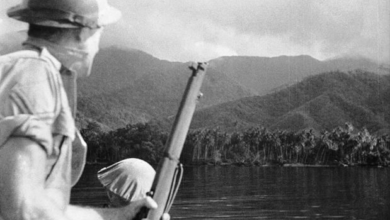
The village of Isurava was the site of one of several desperate battles fought by Australian troops during their retreat along the Kokoda Track. Their position at Deniki becoming untenable, the 39th Battalion, then the only Australian unit confronting the Japanese on withdrawal to Isurava on the night of 14 August 1942. Poorly equipped, the battalion had to dig-in with bayonets, bully beef tins and helmets. The 39th was fortunate that the Japanese did not immediately follow up their success at Deniki and a lull in the fighting ensued for almost a fortnight, allowing reinforcements from the 21st Brigade to begin moving forward.

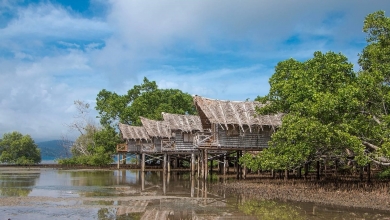
Isurava 1

Isurava Village Circa 1942 taken by Australian Soldier with Box Brownie

On 26 August the Japanese clashed with the 39th's forward outposts at Isurava heralding that their next attack was developing. The same day the first two companies of the 2/14th Battalion arrived to relieve the 39th's exhausted young soldiers, the average age of whom was 18. The next afternoon the 39th's left flank was heavily attacked and while the Japanese were able to penetrate one of the company positions, they were beaten off by two quick counter-attacks. Fighting swirled all around the forward arc of the position throughout 28 August as the Japanese sought a weakness in the Australian defences to exploit.

. Isurava 2

MAJOR A. G. CAMERON, ACTING COMMANDING OFFICER OF THE 39TH AUSTRALIAN INFANTRY BATTALION (RIGHT) AND CHAPLAIN FOURTH CLASS REVEREND N. J. KARL, PADRE OF THE BATTALION (LEFT).

The rest of the 2/14th Battalion arrived this day and its commanding officer, Lieutenant Colonel Albert Key assumed command of the area. Although the 39th now had the chance to withdraw for a well-earned rest, its commander, Lieutenant Colonel Ralph Honner, aware of the onslaught the 2/14th would face, decided it would remain in place. The men of the 39th, however, were moved into positions to the rear to allow the 2/14th to occupy the most threatened parts of the positions.

Isurava 3

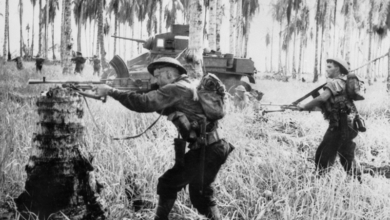
MEN OF THE 2/14TH AUSTRALIAN INFANTRY BATTALION SHARPEN THEIR BAYONETS ON A GRINDSTONE THEY HAD DISCOVERED IN A PLANTATION PADDOCK.

The morning of 29 August brought ferocious attacks right around the forward arc of the position. The first company to give way was C Company of the 2/14th and the Japanese poured through the gap, threatening the whole position. A counter-attack met them head-on, Private Bruce Kingsbury was to the fore, rushing forward and sweeping the Japanese with his Bren gun. A sniper's bullet killed Kingsbury, who was subsequently awarded a posthumous Victoria Cross for his actions but the counter-attack had momentarily restored the situation. The Japanese continued to press home their attack throughout the afternoon. C Company was forced to give ground and D Company, astride the trail, broke around 3pm, having repulsed 11 previous attacks on its positions. As night closed in the position at Isurava was in danger of being overwhelmed and a withdrawal of just over a kilometre to positions around the Isurava Guest House was conducted.

The Japanese followed close on the heels of the Australians and 30 August brought no respite. With some of the companies under his command now struggling to muster a full platoon, Key lacked the troops to cover the high ground to his left, a weakness the Japanese quickly exploited. They heavily attacked the Australians' right rear threatening to cut the track behind them. A further withdrawal was ordered at 3pm but many had to fight their way out, including Key's command group. When the 2/14th mustered at Alola the next morning 172 personnel were missing in addition to those known to be dead and wounded.

Isurava 4

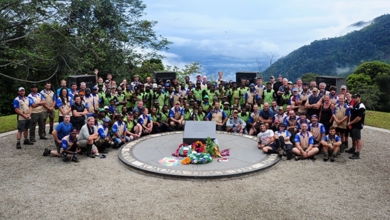
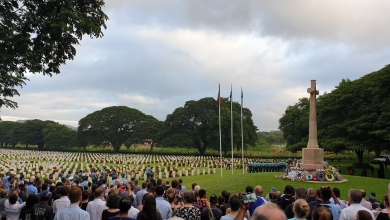
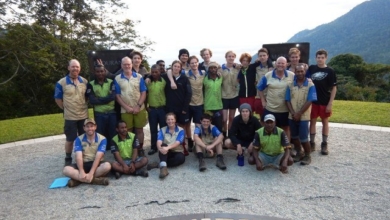
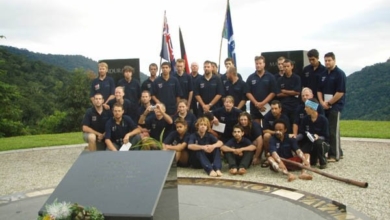
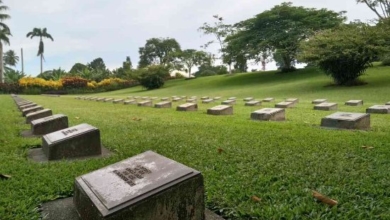
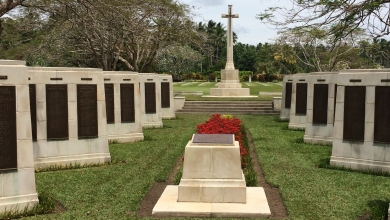
The peaceful Isurava memorial as it stands today.

At Isurava the Australians had been overwhelmed by superior numbers which, poorly equipped and supported, they could never match. Although the 2/14th Battalion was experienced and relatively fresh, its potential to wrest the initiative from the Japanese was undermined by the torturous march along the Kokoda Trail which meant that it could only be employed in the piecemeal fashion in which it arrived at Isurava. The delay imposed there, however, did allow time for the other battalions of the 21st Brigade to make their way forward.

Isurava 5

D COMPANY, 39TH BATTALION, RETURNING TO THEIR BASE CAMP AFTER A BATTLE AT ISURAVA. RIGHT TO LEFT: WARRANT OFFICER 2 R. MARSH, PRIVATES G. PALMER, J. MANOL, J. TONKINS, A. FORRESTER AND GALLIPOLI VETERAN STAFF SERGEANT J. LONG.


Add comment

We welcome all kinds of thoughts - supportive, dissenting, critical or otherwise.
We do not delete or censor comments unless they have content that is abusive, off-topic, promotes hate of any kind, uses excessively foul language or is blatantly spam.
If you find that your comment isn’t immediately showing up, it may have been erroneously flagged as spam. Please email us at info@kokodahistorical.com if it hasn’t shown up after 24 hours and we will do our best to sort it out.


Security code
Refresh

Banner

Trek Dates

30 Jul – 10 Aug 2010:
Kokoda Track Tour

27 Jul – 10 Aug 2010:
Kokoda Track + Beachheads Tour

20 Sept – 1 Oct 2010:
Kokoda Track Tour

20 Sept – 4 Oct 2010:
Kokoda Track + Beachheads Tour

25 Oct – 5 Nov 2010:
Kokoda Track Tour

25 Oct – 8 Nov 2010:
Kokoda Track + Beachheads Tour

Tour Dates for 2011


Banner
Facebook MySpace Twitter Digg Stumbleupon RSS Feed 

Polls

The Fuzzy Wuzzy Angels played a fundamental role in the Kokoda Campaign. What was the estimated average weight that each Fuzzy Wuzzy Angel carried?

Newsletter Subscription


Testimonials

Kokoda Historical: Graham, Michael, Robert and Scott Rosengreen.
We haven't stopped talking about the Kokoda trek since we arrived home.  We can't thank you enough David for the wonderful experience you gave us.  Your knowledge of the track, the people, and in particular our wonderful military history on the Kokoda track and other battles in PNG is outstanding. 
I couldn't imagine doing the trek and not knowing of the lost battlefields that you filled in for us so professionally.  Our main reason for going to Kokoda was to walk in the footsteps, pay homage and acknowledge the extreme sacrifice of so many young men who willingly gave their lives for us. 
We couldn't have done it without your expertise, and the friendliness and support of the Legends.  Thank you so much,  Graham, Michael, Robert and Scott Rosengreen.


Kokoda Historical: Shane Aubrey

I want to thank you (David) for a fantastic trip, your entertainment and knowledge of the battle sites was of the highest professional standard I have encountered for many a year. The trek was without question the hardest and most exciting, thrilling trip I have ever been on and I have been on many deployment etc.

Without a doubt we all have a much higher respect for the diggers who served on the track. What those guys endured we will never fully comprehend. To have a taste of what life must have been like, puts our normal dull life back into perspective and something that will always remain with us.

I am so charged after the trip, I feel that I need to go on another adventure ASAP. David, thank you and your troops, they are all excellent ambassadors for your company and it shows that you have a well trained crew of professionals.

Shane Aubrey, July 2009 
Business Development Manager


Kokoda Historical: Sean Teasdale, Australian Air Force

I would firstly like to thank the whole team at Kokoda Historical for making my trip one of the best things that I have done in my life to date. The professionalism shown by the team along the track was amazing and the knowledge of all members is to be commended. Gary was a wealth of knowledge and seemed to just love every minute of the track and the history that went along with that. But easily one of the best things about the track was Gary's relationship with the legends which led in turn to all of us being able to bond with the legends, which by the looks of things many other tour groups missed out on. I would definitely recommend Kokoda Historical to any friends and family that were looking to trek the Kokoda Track.


Kokoda Historical: Anthony Fuster

Just wanted to thank and to congratulate Kokoda Historical on the fantastic trip that I had! The organisation was exceptional and our tour guide Gary was superb! His knowledge and passion for the history of track meant that I didn't just leave having walked the track, but left with huge appreciation and awe of those who trekked before in such harsh and treacherous conditions. You know you have a good tour guide on your hands when other tour groups stop to listen in on the background and significance of certain parts of the track!

Our group was also fantastic. Being a part of such a small and cohesive unit meant that we were able to bond more closely then we would have been able to had the group been larger. Although Michael was the only one not from ADFA who was in our group, the humour and common appreciation that we shared meant that we gelled quickly!

Finally I'd like to thank the Legends! Those young men are fantastic and are a testament to those who walked the track before them. The passion they showed for their job made it that much more enjoyable.


Kokoda Historical: Gavin Wright RAAF

Gavin Wright, RAAF

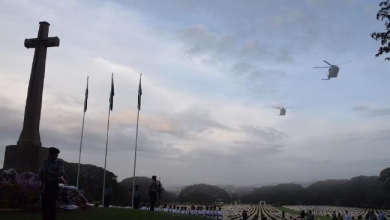
What a wonderful trip, the best and hardest thing I have under taken in all of my 40 years. Dave is a wealth of knowledge on the Kokoda war history as well as local history and current Papua issues. His great sense of humour and attitude kept everyone’s spirits high and helped you forget how hard the day’s walk really was. The legends that walked with us were just that “LEGENDS”. ANZAC day was one of the most moving I have ever attended; Isurava Memorial is very spiritual and picturesque at dawn and the perfect location with all of its history to hold a dawn service. ANZAC day is also a very special and memorable to the Papuans. I will be doing the track again and taking two of my sons next time. Thank you very much for the journey Kokoda Historical.

Read about Gavin's Kokoda Historical Tattoo here!